



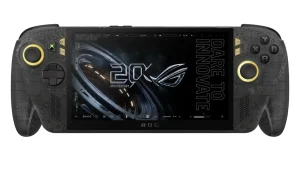
Hello there, handheld hunters, OLED believers, and anyone whose wallet just developed a dead pixel. ASUS has finally priced the ROG Xbox Ally X20. The new black-and-gold anniversary handheld costs $1,299 on its own, launches October 15, and asks buyers to pay $300 more than the 2025 ROG Xbox Ally X.
The screen is meaningfully better. The controls have been refined. The translucent anniversary chassis looks expensive because ASUS worked very hard to make it look expensive. Under that presentation, however, the X20 keeps the same AMD Ryzen AI Z2 Extreme processor, 24GB of LPDDR5X memory, 1TB SSD, and 80Wh battery capacity listed for last year’s $999.99 model.
That does not make the X20 fake, pointless, or secretly identical. A display is the part of a handheld you stare at every second, and better controls matter every second your thumbs are involved. It does make the price the story. ASUS is charging a 30% premium without moving the device into a new core-performance tier.
The Game Cookies position: The ROG Xbox Ally X20 is a credible luxury refresh with an excellent display upgrade. At $1,299, it is also a test of how much collector styling and interface polish can be sold as progress when the processor, memory, storage, and battery capacity remain familiar.
$300 buys a better front end, not a new performance tier
ASUS opened pre-orders on August 25. The standalone X20 is $1,299, while a larger anniversary bundle costs $2,499. The 2025 ROG Xbox Ally X remains listed by ASUS at $999.99. Subtract those prices and the refresh costs roughly $300 more, approximately 30% above the older premium model’s listed price.
The two spec sheets name the same Ryzen AI Z2 Extreme processor, the same 24GB memory capacity, the same 1TB PCIe 4.0 SSD capacity, and the same 80Wh battery capacity. The older Ally X weighs 715 grams. The X20 is listed at 756 grams, an increase of 41 grams, or about 5.7%. It also grows from 29 centimeters to 30 centimeters wide.
⭐ Byte: The clean comparison is price and listed hardware, not untested frame rates. A shared processor, memory capacity, storage capacity, and battery size strongly suggest the same core performance class. Improved cooling, firmware, and power behavior could still change sustained benchmark results. ASUS has not published a quantified X20 performance uplift over the 2025 Xbox Ally X, so we should not invent one or declare every game numerically identical before independent testing.
🦊 Kiki: Okay, ASUS. I am trying to admire the OLED. Please stop making me look at the receipt.
I can hear the checkout now. ‘What’s new?’ ‘The screen, sticks, controls, cooling, and gold.’ ‘The processor?’ ‘Same.’ ‘Memory?’ ‘Same.’ ‘Battery capacity?’ ‘Same.’ ‘Price?’ ‘Very new.’
ASUS found the one component guaranteed to run faster: the bill.
🍪 Chip unrolls the receipt, reaches the floor, and keeps floating upward because gravity has declined to finance this purchase.
The OLED upgrade deserves real credit
The strongest case for the X20 is sitting directly in front of the player. The 2025 Ally X uses a 7-inch, 1080p IPS-level display rated at 500 nits with a 120Hz refresh rate and FreeSync Premium. The X20 moves to a 7.4-inch, 1080p OLED panel with a 120Hz refresh rate, FreeSync Premium Pro, Dolby Vision support, 600-nit SDR brightness, and up to 1,400 nits for HDR highlights.
That is not a decorative swap. OLED can deliver true blacks, stronger contrast, rapid pixel response, and a more convincing HDR image. ASUS also says the anti-reflection treatment cuts unwanted reflections by 65%. Tom’s Guide reported a clear difference in brightness, black levels, and color when comparing the devices side by side during a hands-on session, though a full review remains necessary.
The controls receive practical changes too. The X20 adds magnetic TMR joysticks, a transforming four-way or eight-way D-pad, reshaped face buttons, revised bumpers and triggers, textured rubber grips, and an updated cooling system. Its microSD Express reader and 68W adapter are also changes from the older model’s listed configuration.
🦊 Kiki: Annoyingly, the OLED is gorgeous. I wanted to dismiss this as a $300 costume change, then the blacks went black and my argument briefly left the room.
Fine. Better screen, better sticks, better buttons. Real upgrades. Now explain why giving the premium handheld the premium display a year later earns anniversary tuition.
ASUS fixed the obvious omission and invoiced us for the character development.
🍪 Chip dives into the OLED’s perfect black level and briefly disappears, except for two glossy eyes and one deeply concerned chocolate chip.
Anniversary hardware follows collector logic
ASUS is not pretending this is the mass-market model. The X20 celebrates 20 years of Republic of Gamers with a semi-translucent chassis, gold-accented internal structure, gold-plated fans, illuminated joystick rings, and an anniversary badge. It is designed to feel limited, visible, and collectible before a benchmark chart enters the room.
Collector products do not have to justify every dollar through frames per second. A special-edition controller can cost more because somebody loves its finish. A mechanical watch can cost more while telling the same hour. The buyer is paying for materials, scarcity, identity, and the pleasure of owning a particular object. That is a legitimate market, provided the product is sold honestly as a luxury choice.
The tension is the Xbox name on the front. Xbox has spent years promoting access across devices, stores, subscriptions, and cloud services. A $1,299 handheld wearing that identity sits at the opposite end of accessibility. It is a Windows gaming PC made with Xbox, not a replacement for a $500 console, but branding shapes expectations even when the footnotes are technically perfect.
🦊 Kiki: Buy the gold one. I understand. My common sense has been defeated by translucent plastic before.
I can hear collector brain already. ‘Same processor.’ ‘Yes.’ ‘$300 more.’ ‘Correct.’ ‘But the fan is gold.’ ‘Add to cart.’
Performance never entered the battle. The gold fan aggroed your frontal lobe and won.
🍪 Chip polishes one tiny gold fan until he sees the reflection of a payment-plan calculator staring back.
The $2,499 bundle says the quiet part clearly
The bundle removes any doubt about the intended audience. For $2,499, ASUS includes the X20, ROG XREAL R1 Edition 20 gaming glasses, a custom dbrand Killswitch case, and a Pelican protector case. ASUS sells the anniversary glasses separately for $799. They use two 1080p Micro-OLED displays to create what ASUS describes as a virtual 171-inch screen at four meters.
The standalone handheld plus the glasses total $2,098. The bundle therefore places another $401 between that sum and the $2,499 package, covering the custom cases, coordinated styling, and collector presentation. That arithmetic does not prove the bundle is bad value because the accessories have their own costs. It does reveal that utility is not the only product being sold.
At $2,499, this is no longer a convenient way to enter PC handheld gaming. It is an enthusiast display system and commemorative object. ASUS has every right to build that object. Buyers should evaluate it with the same clarity ASUS used when selecting all that transparent plastic and gold metal.
🦊 Kiki: $2,499 is the moment the shopping cart asks whether you have discussed this with your household.
Handheld. AR glasses. dbrand case. Pelican case. The package keeps nesting protection around the purchase until the only exposed object is your bank account.
The accessories arrive in armor. Your savings do not.
🍪 Chip climbs into the protector case and discovers the only accessory missing is a smaller case for the receipt.
The verdict belongs to the buyer ASUS chose
For an owner of the 2025 ROG Xbox Ally X, the X20 is difficult to frame as a performance upgrade. The processor, memory capacity, storage capacity, and battery capacity remain the same on paper. The stronger reasons to switch are display quality, control feel, physical design, and collector appeal. Those are real reasons, but they are personal rather than generational.
For a new buyer who wants the best display in this specific Ally design and does not mind paying for an anniversary model, the choice is more defensible. The X20 appears to fix the most obvious omission in the premium Ally X while refining several points of contact. It may become the nicest version of this hardware. Nicest and best value are different awards.
The ROG Xbox Ally X20 is not offensive because it costs $1,299. It is revealing. The premium handheld market has grown confident enough to charge laptop money for a device whose central performance hardware did not need to change. ASUS is betting that the screen, controls, finish, and collector story will carry the difference. Some buyers will happily confirm that bet. Everyone else should remember that the $300 premium buys a better experience around the chip, not a new chip.
🦊 Kiki: Here is the buyer test. If you saw $1,299 and thought, ‘Finally, the OLED one,’ ASUS found you. Enjoy it. I mean that.
If you saw the same processor, memory, storage, and battery capacity and started negotiating with yourself, close the tab. Collector brain is already putting the gold fan in the cart.
ASUS built a very good handheld and a very efficient personality test. If you are still staring at the gold fan, the test is over.
🍪 Chip closes the tab, opens it again, and blames the refresh rate.
⚙️ Stay spec-literate like Byte separating shared hardware from untested benchmark claims.
⚙️ Keep the fair objection visible: the OLED and control upgrades are substantial even when the value case is not universal.
⚙️ And remember: perfect blacks do not make the price invisible.
🦊 Kiki · 🍪 Chip · ⭐ Byte · 🦁 Leo
Tips, leaks, and luxury receipts: contact us here!
Follow Game Cookies on social.
Daily bites on the platforms you already scroll. Pick your poison.