



Hello there, pixel detectives, frame-rate hunters, and neural-rendering skeptics…
On August 26, NBA 2K27 entered PC early access. Players looking through its files soon found something that was not advertised on the feature list: a 158 MB NVIDIA library named nvngx_dlssnr.dll. VideoCardz identified it as NVIDIA DLSSNR version 310.8.0.0, apparently connected to the unreleased DLSS 5 Neural Rendering technology.
NBA 2K27 does not expose a DLSS 5 or Neural Rendering option, and NVIDIA has not announced the game as a supported DLSS 5 title. The file’s presence therefore confirms a publicly accessible runtime, not an official working integration inside the basketball game.
That limitation lasted only a few hours. Members of the RenoDX modding community got the library operating inside Control, applying neural rendering to character models and exposing seven reported visual styles. Experiments then began appearing in other games. NVIDIA planned to introduce DLSS 5 through controlled developer integrations. Modders turned the first public copy into a live argument about faces, performance, and artistic authority.
A 158 MB file arrived before the product
NVIDIA announced DLSS 5 in March as a real-time neural rendering model designed to add photoreal lighting and material detail. According to the company, the model takes a frame’s color and motion vectors as input, analyzes elements such as skin, hair, fabric, and lighting, and produces temporally stable enhancements anchored to the original 3D scene.
The pitch moves DLSS beyond its familiar jobs of reconstructing resolution and generating frames. DLSS 5 is supposed to transform the final visual presentation itself. NVIDIA says developers will receive controls for intensity, color grading, and masking so artists can decide where the neural pass applies and how strongly it affects the frame.
The leaked runtime offers none of the reassurance that comes from a finished game, an art team’s tuning, a documented preset, or an official driver and SDK release. Its value comes from a different place. It shows what the model can start doing when people obtain the runtime before the surrounding production decisions are ready.
🦊 Kiki: I am annoyingly pro-tool. Give artists better lighting, faster iteration, strange new shaders, whatever helps them make something good. But a tool earns trust by knowing who gives the orders. NVIDIA promised intensity controls, color grading, and masks. The first public experiment skipped the art team and went straight to, ‘Jesse, congratulations, the internet selected Face Preset Six.’ The fair defense is obvious: hacked integration, unfinished model, no developer tuning. Agreed. That defense also explains the controversy. Remove the artist from an artist-controlled feature and the technology immediately starts auditioning for the wrong job. If the model needs the art director gagged before it looks impressive, close the casting call.
🍪 Chip raises a tiny director’s slate, notices the model already called action, and bites the slate shut.
The unofficial tests removed the safety rails
The RenoDX experiment is rough by its creators’ own reported conditions. The implementation initially affected character models, HDR was not working correctly, and the work had not entered a public RenoDX release when VideoCardz documented it. The neural pass also appeared late in the rendering pipeline, after upscaling and possibly after tone mapping.
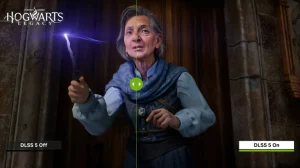
Public demonstrations nevertheless show why the subject caught fire. Control comparisons can deepen shadows, alter light transmission through skin and hair, and change the way a character’s face reads even when the underlying geometry remains recognizable. Other reports describe modded tests in Cyberpunk 2077 and Kingdom Come: Deliverance II.
A screenshot can make those changes look like a simple before-and-after upgrade. Games are authored sequences, not isolated portrait photographs. A lighting shift that flatters one close-up can flatten a mood elsewhere. More realistic skin can fight a stylized face. A neural model can preserve geometry while changing the visual emphasis that made the original frame feel intentional.
One frame-rate result needs a large warning label
The sharpest performance figure so far comes from one unofficial Control test reported by Tom’s Hardware. On an RTX 5070 Ti at 4K, performance reportedly fell from 71 frames per second to 35 after the modded neural-rendering pass was enabled.
The developer did not disclose the DLSS 5 style, intensity, internal rendering resolution, or the rest of the test configuration. That missing information blocks a clean comparison with other systems or NVIDIA’s eventual release. The result describes one early experiment, on one GPU, in one game that was never built around this implementation.
⭐ Byte: The reported Control test compares 71 FPS with the neural-rendering pass off against 35 FPS with the modded pass on at 4K on one RTX 5070 Ti. That is a 36 FPS loss, or about 50.7 percent. The settings, internal resolution, and neural-rendering preset were not disclosed. This is a single unofficial implementation, not a controlled benchmark of the final DLSS 5 release. The number measures the cost of that test configuration only.
NVIDIA has marketed the earlier DLSS generations around performance as well as image quality. The DLSS 5 announcement deliberately shifts the headline toward visual fidelity. That evolution may be technically coherent, but the familiar name carries years of player expectations about higher frame rates. An early test that loses roughly half its performance will collide with those expectations even when the comparison is incomplete.
🦊 Kiki: Gamers have spent years reading DLSS as a magical sentence: more frames, prettier image, hardware lives another day. Then DLSS 5 walks into Control, halves one reported frame rate, and offers new pores as compensation. I can hear the settings-menu negotiation now. ‘Performance mode?’ ‘No, but your cheekbones have ray-traced ambition.’ The early mod can improve massively before launch; treating 35 FPS as final would be dishonest. NVIDIA still attached a familiar performance brand to a feature whose headline act is visual transformation. That confusion was booked at the naming meeting. If the upgrade takes half the frames, the first setting it needs is a very honest price tag.
🍪 Chip counts 71 cookie crumbs, recounts 35, and guards the survivors with both arms.
NVIDIA’s promise depends on artistic control
NVIDIA’s official explanation repeatedly anchors DLSS 5 to developer intent. The company says game pixels must remain deterministic and grounded in the developer’s world, and it presents intensity, color-grading, and object-masking controls as the mechanism that protects each game’s aesthetic.
That position also matches the broader technical context. In NVIDIA’s own neural-rendering overview, DLSS 5 sits in the family of techniques that apply machine learning to a conventionally rendered result for a quality or style uplift. The source render still matters. The model is working on top of an authored frame, not replacing the entire game engine.
A good shipping integration could use that relationship carefully. Artists might enhance skin response in one close-up, protect a stylized character with a mask, reduce structural intensity in another scene, or leave the effect disabled where it harms the look. Those choices turn neural rendering into another controlled production tool. A default filter applied everywhere would create a very different product.
🦊 Kiki: Realism has become graphics discourse’s easiest scoreboard because it looks objective. More pores. Deeper shadows. Shinier fabric. Number goes up, applause plays. Art direction is the annoying adult asking whether any of that belongs in this game. A stylized face can be finished without looking photographed. A painterly world can reject physically perfect skin and still be exactly right. NVIDIA’s masking tools may let developers keep control, and if they do, great. Give the tool a chair. Give the artist the final vote. The second the model starts approving everybody’s cheekbones, it has confused rendering with management.
🍪 Chip: Chip places a tiny ART DIRECTOR card on Kiki’s chair and slides the neural renderer’s chair into the hallway.
Modders created the most useful pressure test
The experiments cannot predict the shipping product. They still expose the questions that final implementations must answer: how much performance the pass costs, which scenes and objects receive it, whether players can understand the trade, how developers preserve stylization, and how clearly a game communicates that its final image is being transformed after the conventional render.
Modders also turned an unreleased feature into a public laboratory before NVIDIA, publishers, or marketing departments could choreograph the demonstration. That is uncomfortable for every company involved and useful for everyone evaluating the technology. Extreme settings and broken integrations reveal failure modes. Careful implementations can later prove that the controls work.
DLSS 5 deserves judgment from completed games running official builds. The leak has already established the standard for that judgment. Sharp screenshots will not settle it. Artistic control, player choice, temporal stability, and an honestly measured performance cost belong in the same frame.
In the end…
The leaked DLL gave players an unfinished answer to a finished question: who gets the final say over a game’s final look? NVIDIA says the artist does. Every official DLSS 5 implementation now has to make that promise visible in the result, the controls, and the performance bill.
⚙️ Stay skeptical of comparisons stripped from their settings.
⚙️ Keep the artist controls inside the graphics conversation.
⚙️ And remember: more realistic pixels can still produce weaker art direction.
🦊 Kiki · 🍪 Chip · ⭐ Byte · 🦁 Leo
Tips, leaks, and suspicious neural pixels: contact us here!
Follow Game Cookies on social.
Daily bites on the platforms you already scroll. Pick your poison.